

Renewed Renaissance
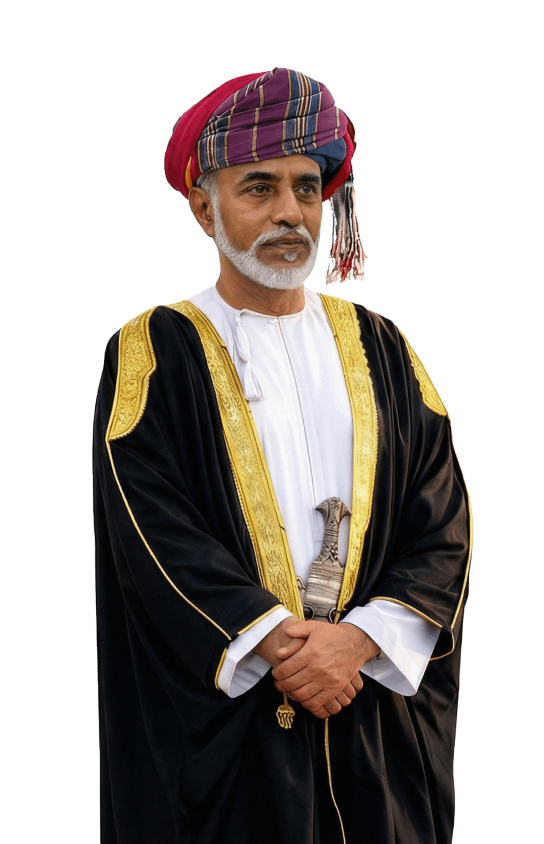
His Majesty Sultan Haitham bin Tarik
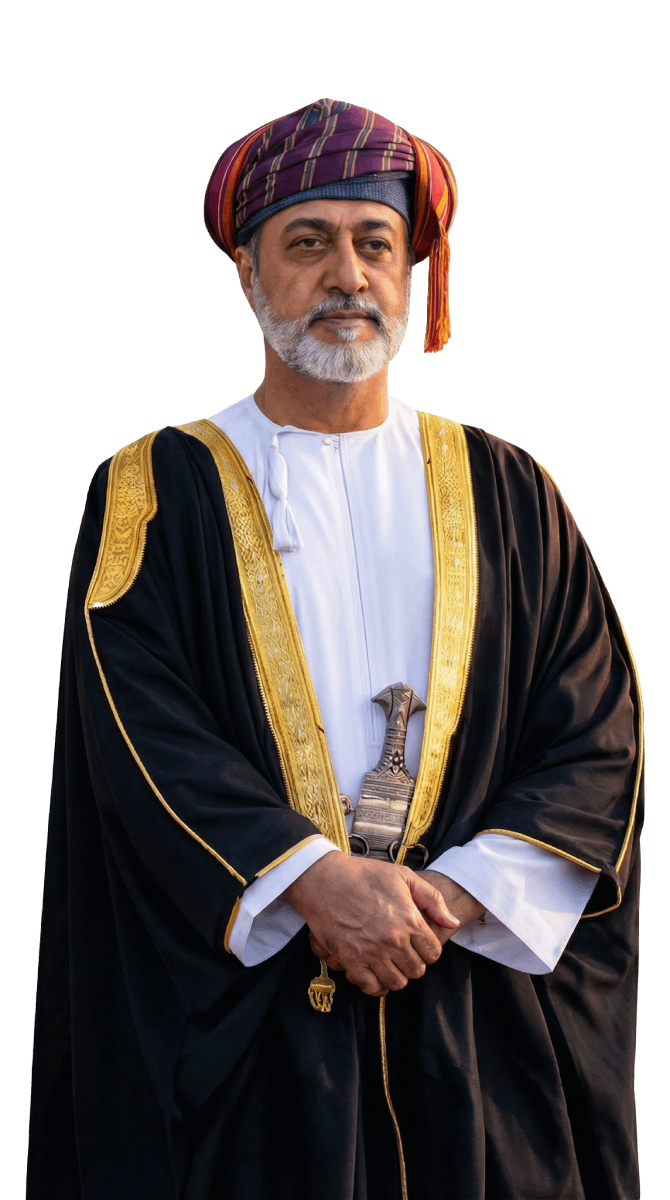
His Majesty Sultan Haitham bin Tarik was born in Muscat on the eleventh of October 1955. He received his primary education at Al Saidiya School in Muscat. In middle school, he joined one of the Lebanese schools “Brummana High School”. Afterwards, he went to the United Kingdom to continue his secondary school and higher education at one of the most prestigious universities in the world, Oxford University, Pembroke College.
His Majesty has varied interests including sports, as he chaired the first Omani Football Association from 1983 to 1986. This phase witnessed the establishment of many regulatory aspects in the sector of football and sport clubs in Oman. During this period, the Sultanate of Oman hosted the seventh Gulf Cup Championship. His Majesty also chaired the organizing committee for the Second Asian Games (Asiad), hosted by Oman in 2010.
During his career, His Majesty received several royal awards. In March 2001, he was awarded the Grand Medal of Honor for Services, rendered by the Republic of Austria. In December 2006, he received the Necklace of the Order of Abdulaziz Al Saud. Moreover, he received the Honorary Knight Grand Cross of the Royal Victorian Order (GCVO) from the United Kingdom, in November 2010, and Al Russoukh Medal, from Sultan Qaboos bin Said – may Allah rest his soul in peace – in the same period, in addition to Al Said Medal, Oman Medal, and the Omani Renaissance Medal.
Sultan Haitham bin Tarik held several positions throughout his career. He served as the Undersecretary of the Ministry of Foreign Affairs for Political Affairs from 1986 to 1994, then, Secretary-General of the Ministry of Foreign Affairs (1994–2002). From 2002 to 2020, His Majesty held the position of the Minister of Heritage and Culture. In addition, he chaired several committees, the most important of which was the main committee for Oman Vision 2040.
On 11 January 2020, through a swift transition of power, His Majesty Sultan Haitham bin Tarik came to the throne, succeeding the late Sultan Qaboos bin Said bin Taimur – may Allah rest his soul in peace.
Sultan Qaboos bin Said
Sultan Qaboos bin Said – may Allah rest his soul in peace – was born on 18 November 1940 in Salalah city, Dhofar Governorate. He is the eighth Sultan of Oman in the direct line of Al Busaid family, which was founded by Imam Ahmed bin Said in 1744.
His Majesty Sultan Qaboos began his first stages of education in Oman. Afterwards, his father, Sultan Said bin Taimur, sent him to England in September 1958, to complete his education. He spent two years in a private educational institution in Suffolk. In 1960, he joined The Royal Military Academy Sandhurst, as an officer candidate. After two years, he graduated and joined the command of one of the British infantry battalions operating at the time in West Germany, which is the first battalion – The Cameronians (Scottish Rifles) for six months. After that, he studied local government systems and administrative affairs, and then toured the world to learn about different regimes. In 1964, he returned to the Sultanate of Oman and spent most of his time learning more about the sciences of Islamic law and Oman’s history and culture.
His Majesty Sultan Qaboos had a variety of hobbies and interests. He was a skilled horse rider interested in horses and some sports such as shooting, walking and tennis. He was also an ardent book reader especially on history, politics and science. He was also interested in photography, music, astronomy, and planet observation. His Majesty also paid special attention to preserving the Omani environment.
His Majesty had several cultural and civilizational contributions in several fields such as environment, culture, arts, literature, volunteer work and various scientific fields at the local, regional and international levels. He is internationally recognized for promoting the values of tolerance and peaceful coexistence among the countries of the world, including the announcement of Sultan Qaboos’ project for the humanitarian author on November 16, 2019.